The Narrative of Making and Making Narratives
BIOS
Warwick Freeman (b.1953, Nelson) began making jewellery in 1972. As a prominent member of Auckland Jewellery Co-operative, Fingers, he was at the forefront of a rethinking of New Zealand contemporary jewellery practice that began in the 1980s. He has exhibited internationally since that time. In 2002 he was made a Laureate by the Francoise van den Bosch Foundation based at the Stedelijk Museum. In the same year Freeman received a laureate award from the Arts Foundation of New Zealand. In 2014, Freeman co-curated the exhibition Wunderrūma, with jeweller, Karl Fritsch. Wunderrūma was presented at Galerie Handwerk in Munich, and on its return to New Zealand at Auckland Art Gallery Toi o Tāmaki.
Freeman has also been involved in governance and curatorial activities: in 2004 he became the inaugural Chair of Objectspace, a public gallery dedicated to the exhibition of craft, design and architecture. His works are held in public and private collections in New Zealand and internationally including the Museum of New Zealand Te Papa Tongarewa, the National Gallery of Australia, Canberra, the National Gallery of Victoria, Melbourne, the V&A, London, the Pinakothek der Moderne, Munich, LACMA, Los Angeles, the Houston Museum of Fine Arts and Stedelijk Museum, Amsterdam.
Kim Paton has been the Director of Objectspace since 2015. Her interest is in interdisciplinary exhibition making across the fields of craft, design, architecture and contemporary art. Paton has curated and written extensively on object-based art forms, including for the new Warwick Freeman monograph Hook Hand Heart Star, published by arnoldsche Art Publishers. Paton is the co-editor of the publication The Chair: A story of design and making in Aotearoa (2024), and co-authored the book Contemporary Jewellery in Context, published by arnoldsche Art Publishers (2017).
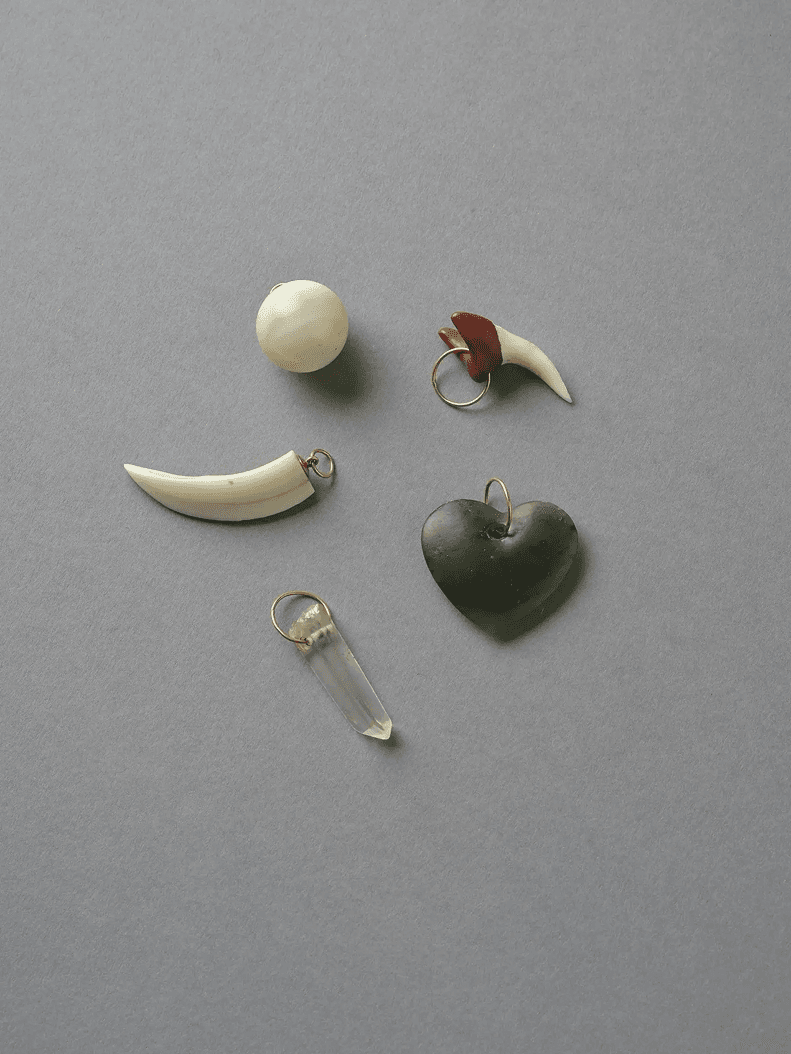
At 19:00 on Friday 14 March, a retrospective exhibition on Aotearoa New Zealand jeweller Warwick Freeman opens at Die Neue Sammlung – The Design Museum at Pinakothek der Moderne, Munich. Across five decades Freeman has built a lexicon of signs: from the cultural symbolism of the hook and the star to the heart redrawn in the volcanic scoria of Rangitoto Island in Tāmaki Makaurau Auckland. When worn, his jewellery communicates something of who we are and how we have lived in Aotearoa.
Presented in Munich, where Freeman has forged enduring connections and received inspiration from the jewellers, galleries and initiatives that sustain this city as a centre for contemporary jewellery, the Hook Hand Heart Star exhibition and publication are a koha for Munich, its people, and the international jewellery community. Woven through this project are decades of exchange across hemispheres and the spirit of an ongoing collaboration – between Munich and Aotearoa, Die Neue Sammlung and Objectspace, and Freeman and curators Petra Hölscher, Kim Paton and Bronwyn Lloyd. Ahead of travelling to Munich for the launch of Hook Hand Heart Star, Kim and Warwick sat down to talk about the development of the show, from defying the chronology to identity and endurance.
- KP - Kim Paton
- WF - Warwick Freeman
We’re sitting here a month before Hook Hand Heart Star launches in Munich – a project we’ve been in near daily conversation about for three years, and I had this moment the other day where I realised that how I see this show and how you see it can’t be the same thing, because you’re in it and I’m sitting on the edge making meaning of it. So, I thought we could focus this kōrero (conversation) around the myth making exercise of a survey exhibition, the mythologising that is in your work and practice, and maybe do some myth busting together?
The idea of the survey, the retrospective, is to pull things together over time – the usual impulse is to present a big body of work as though it says everything about an artist, but it’s no exaggeration to say that you have been very, very uninterested in pursuing that as a line of inquiry for Hook Hand Heart Star. And one of the ways that you’ve articulated that from the beginning is through rejecting a chronological organisation of your work. Why do you rail against the chronology?
The chronology can be incredibly undermining, you know, it sucks up the energy and presence of the now. You can abandon your normal processes of working and position the work as all behind you, ring it off, and that’s not always what is best for the work. It can leave you hanging, when you lose the ‘making’ energy, and you’re left going, what now?
Putting together this show has tested your denial of the chronology and I think that you have been proven right – that there’s a more interesting way to consider your practice. Instead, five decades of your work are arranged into thematic groupings, which gives a more accurate representation of how ideas and ways of working have been used by you over many, many years, with works revisited and recontextualised in the language of your practice.
Because of how I work, there have been moments when a work has been mis-dated, so you’re looking at it and assessing a piece 20 years outside of its production time. In those moments I’d realise that somebody might have a hard time pinning down when a work is made because it is part of an ongoing vocabulary. A piece has a cultural time and place, and there are works that signpost their position in my archive through construction methods or materials, but they can still be revisited and find relevance within my ongoing practice.
Let’s go to a signpost. If we want to mythologise contemporary jewellery from Aotearoa, we start with Bone Stone Shell, it refers to the 1988 exhibition that toured internationally, but also to a whole range of activity and exhibition making that was happening at that time.
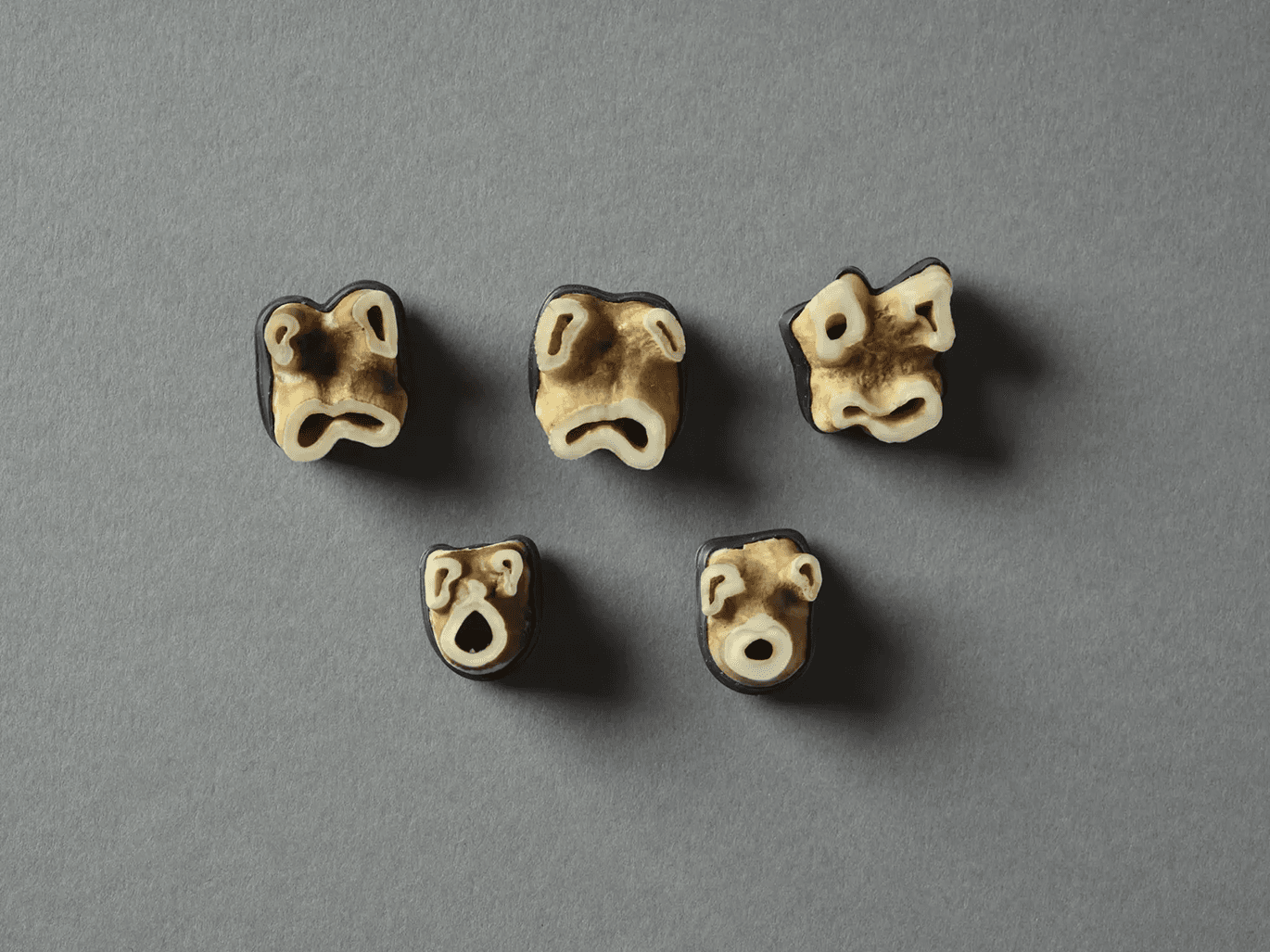
That show and time have definitely been mythologised as a kind of founding story for Aotearoa jewellery. If you have a good founding story, it’s probably more interesting to hold onto it and embellish it than to assert that it wasn’t quite like that, but when you’re in the time there’s no manifesto or instruction manual outlining what you’re doing. Work was mostly happening in people’s isolated studios, and as makers we assessed the materials and adopted the same sort of approaches – it was quite remarkable in that. If you want to mythologise anything it should be that something was in the air. The New Zealand government’s initiative to tour Aotearoa craft internationally and their naming of Bone Stone Shell positioned the show to become part of the canon. I remember I was in the meeting where we landed on that title, it was one of those moments where you’ve been over so many options that the working title just sticks. It could have been ‘Stone, Bone, Shell,’ imagine the horror. But there was so much happening around it, through the 70s and 80s in New Zealand – the political climate, the craft movement, everything fed into it. I don’t know if the touring initiative was meant to generate tourism, but it contributed to the generation of a particular cultural identity for New Zealanders, an articulation of who we are.
Bone Stone Shell is often talked about in connection to an abandonment or rejection of Western or European jewellery traditions – as an expression of the non-precious materials movement that was dominating contemporary jewellery internationally. It’s not that straight a line, is it?
In Europe and Great Britain, the rejection of preciousness developed a sort of manifesto: no more diamonds, no more gold. There was a critique of the value and prestige attached to these materials, and the ambition was to elevate whatever alternative – rubber, paper – to the status of acceptable jewellery. We were on the other side of the world sourcing natural materials for free and overtly pointing to the fact that they were already precious. As an example, the 1981 Pāua Dreams exhibition at Fingers gallery came directly out of our government’s decision to drop the moratorium on the export of pāua (New Zealand abalone), so it would be sent offshore and come back as souvenirs that were supposed to express ‘New Zealandness.’ So, we took to making work with pāua, it was Roy Mason’s initiative originally, to kick back at what they were doing to this material.
'A piece has a cultural time and place, and there are works that signpost their position in my archive through construction methods or materials, but they can still be revisited and find relevance within my ongoing practice.'
The entire Bone Stone Shell exhibition was gifted into the collection of Te Papa Tongarewa, our national Museum, by the Friends of Te Papa in 1993, so again that helps with formalising the myth. It endorsed the work that you and other jewellers were doing at the time as an expression of national cultural identity, and as an important record of that moment. It also triggered the development of the contemporary jewellery collection at Te Papa. I fear that I’m talking chronologically here…